
From Process to Destination: Pursuits of Emerging Art Practitioners in“Commuting-Talking”
- Catherine Chan
- 2023年6月30日
- 讀畢需時 6 分鐘

A Review of Samson Wong's Group Exhibition with Para Site

”Commuting-Talking” recorded the artist’s conversations with four ex-classmates, they traveled from workplaces to homes located across Hong Kong Island, Kowloon, New Territories , and Outlying Island. These journeys took place on metro, bus, tram, minibus, and ferry respectively.
Living in a fast paced city, many Hongkongers maximize their commute time by taking a nap or using their smartphones. Do you have the habit of observing your surroundings while commuting? Or have you ever enjoyed the wait before arriving at the destinations? Samson Wong’s“Commuting-Talking”in the group exhibition “Noble Rot (Part 2) ”commissioned by Para Site, provides the audience with a window into the mind of young fine art graduates. The core content of this art piece are video clips of over 3 hours, which recorded interactions between the artist and his friends, and the scenery along the public transport journeys. These seemingly random dialogues touched upon complex issues, ranging from experience at work, to recent explorations in art mediums. Some narrators also revealed their inner struggles, such as the tension between aspiration and reality, relationship with family, future plans and uncertainties etc. This article will cover some observations and inspirations regarding the theme, production process, visual elements, and display of this artwork.
Being recorded in trainsiting public space, the duration of each recording was confined to the transport time taken before the interviewee arrived home. The conversations involved individuals' life and thoughts, following the flow of the small talks, their external encounters elicited inner feelings. In the loose framework of inviting friends for small talks, Samson did not pre-set a specific message to convey. Although these videos use career as the main theme, they do not appear as structured interviews led by a researcher, but more realistic presentations of thoughts at the time of shooting, as if the documentation serves the function of reorganizing the nonlinear thinking processes. Holding the camcorder, the artist retreated to the role of a listener, who responded and asked follow-up questions from time to time while recording. The video camera occasionally captured the interviewees from behind, as well as the other passengers. For most of the time, it was facing the surroundings, such as the roadsides and city lights on moving vehicles, which resemble a relaxing slow TV program. The subjects, during the joking moments, were conscious of the fact that they were being recorded. For example, one concerned saying something inappropriate, sitting in the front row on a minibus to avoid disturbing others, felt embarrassed for exposing where he lives, and doubted whether anyone would have the patience to watch the whole lengthy film that lacks focus. The conversations were conducted in Cantonese, supplemented with Chinese and English subtitles. Samson recalled the transcription and translation process to be the most time consuming procedure. Everyday experience is full of repetitive, trivial, and fleeting details, but we could see how the interviewees selected and narrated fragments that were meaningful for them.
The interviewees in“Commuting-Talking”speak to the audience indirectly through the mediums of documentary and small objects. Instead of showing the videos in specific order on a big screen, the four videos were displayed individually on computer screens in a nostalgic workstation setting, in which viewers could take control in taking seats. The dialogues did not always provide background information we, outsiders need, just like when we were eavesdropping passerbys talking in a public space, and we tried to put the puzzles together. Under the setting of a group exhibition, the length of this work undoubtedly challenges our attention span. This review was completed when the exhibition venue was closed due to social distancing measures, therefore, it is based on the video files and exhibition setup images. I took some short breaks by pausing the videos whenever I felt tired . Each video is like a complete journey of itself, which might bring us some remarkable discoveries along the way.

In a corner of the exhibition space, there were four sets of office desks, with chairs and computers separated by plastic partitions. Beneath the glass covers, was a display of flat objects provided by each narrator.
Hong Kong introduced career planning in secondary education, however a bachelor degree is merely a stepping stone to enter the art profession, and it may not even be a prerequisite. Academic training could equip artists in terms of art history, techniques, and social network in the industry, etc., yet the establishment of artistic styles and exploration of suitable working modes could take much longer. With art-related subjects being regarded as non-mainstream, graduates enter the profession with enthusiasm commonly faced rejections in reality. Some take up multiple jobs to support their art practice, while others even switch to another industry. In a society that valued business over humanities, only a few have the courage to claim themselves full-time artists. Finishing his undergraduate study in 2018 at the Chinese University of Hong Kong, Samson worked as a gallery assistant, and later as a university teaching assistant. In order to instruct students, he taught himself video editing and augmented reality (AR) animation software via online materials. The four people he talked to had been involved in different positions in the art field, thus their situations projected a group portrait of young artists in Hong Kong:
The protagonist of Video I worked as a technical assistant in the Academy of Visual Arts, meanwhile, he was preparing to further study printmaking in the UK, and was dealing with a tedious visa review. He elaborated on his work experience, for instance, he was excited to learn advanced printmaking techniques on the job, and he found that part-time students were generally more devoted than full-time undergraduates. He also expressed the helplessness of not being able to repair malfunctioning equipment because the department was running out of budget. He sighed at the harsh employment policies of tertiary institutions, although it had little impact on him who was about to study abroad.
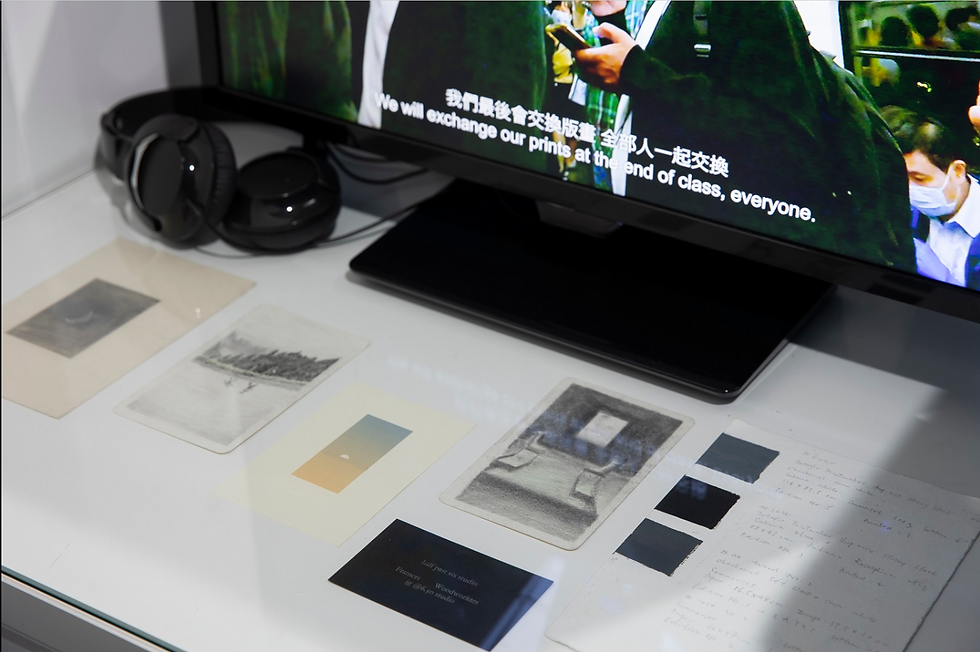
Exhibits of Video I included notes, drafts, and printmaking samples.
The narrator of Video II during his internship in M+, gradually developed an interest in performing arts under his colleagues’ influence. He was taking drama courses in his spare time, since then he turned to express emotions from visual forms to body movements. The days when he arrived home late at night after drama classes, were actually created “breathing space”for him to free from the conflicts with family. After his first part-time job at a cosmetics shop put him in doubt, he changed many jobs in the past few years. Before getting a temporary position at the Hong Kong Museum of Art, he even helped his father with interior furnishing. In the video, he was introduced by a classmate to do gift wrapping for Cartier seasonal VIP events.

Video II described the time pressure of an inexperienced gift wrapper in a luxury store. Sketches, photocopy of diary pages, and notes on dance moves were shown on his desk.
The interviewee of Video III also worked for Cartier, where she was mainly responsible for gift production and storefront design, that was relevant to her study of craftsmanship. Job vacancies in shopping malls and luxury brands were seasonal and impacted by the pandemic, as they were derived from the festival marketing. She revealed that the hourly pay for freelance workers is higher than full-time of the same job nature. The experienced craftsman also provided her with an insider’s perspective of the local craft manufacturing industry.

The desk of Video III displayed gift wrapping items from Cartier, and soil collected from different mountains of Hong Kong for paint making.
The respondent of Video IV became a performing arts administrator by chance. When she first heard her colleagues mention“gau2 dai6”, she thought it was referring to the nine government funded universities in Hong Kong, while it actually means the nine major performing art groups. She believed that besides the glamorous side that outsiders see in the art circle, art administration practitioners were generally underpaid with long working hours and heavy workloads, except for a few who secured well paid positions offered by the government. In desperation, she considered adjusting her career path.

The desk of Video IV was covered with red packets, movie tickets, memos, and film roll etc.
Differentiated from news documentaries in which the videographer presents a dominant viewpoint, “Commuting-Talking”is more like a mirror where viewers may relate their own experience. After listening to the confessions of the four emerging art practitioners, there are moments that I can resonate with their feelings, and some of their stories also refreshed my impressions of the art profession. Knowing that the market for cultural and creative industries in Hong Kong is small, and they are further divided into subcategories. Visual art and performance art were considered two distinct categories with different sets of techniques and operation modes. Of course, as contemporary art is cross-disciplinary in nature, it is beneficial for artists to have exposure to multiple art mediums. Artists pursue perfection in skills and conceptual breakthroughs, whereas art administrative positions require multi-skills, flexibility and strong interpersonal communication to shuffle around parties. The jobs that young artists do for a living unavoidably consume the time and energy that they can devote to artmaking, while in some cases, those may also bring them inspirations. The struggle between dreams and reality is commonly faced by “slashers”regardless of profession. After leaving school, work occupies a major part of our life. Lifelong learning takes forms actively or passively, in which we might be exposed to new knowledge and workplace wisdom, both the gains and confusions along the journey would nurture our personal growth.


留言