
Heroism and Hubris: The Complex Legacy of Timothy Treadwell in Herzog’s Grizzly Man (2005)
- Catherine Chan
- 1月9日
- 讀畢需時 4 分鐘

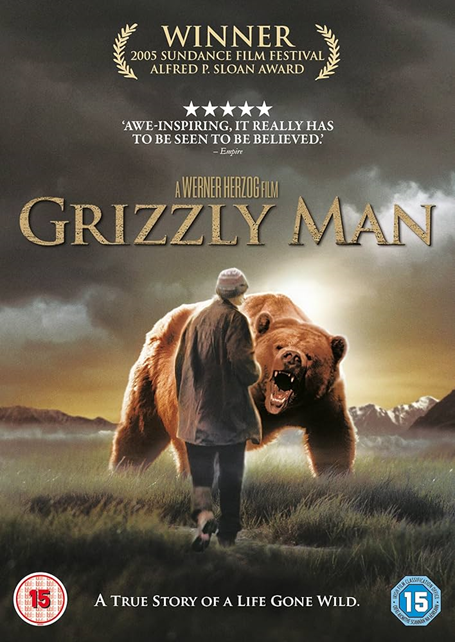
Grizzly Man. Dir. Werner Herzog. Discovery Docs and Lions Gate Entertainment. 2005
Grizzly Man is an American documentary about the life and death of Timothy Treadwell, a bear enthusiast. Over thirteen years, he spent each summer camping in Katmai National Park as a form of healing. Treadwell’s girlfriend, Huguenard, shared his passion for bears and wildlife conservation. Tragically, during their last visit, they were killed by a bear because Treadwell refused to leave before the bears’ preparation for hibernation. Their bodies were discovered in 2003.
I watched this documentary without prior knowledge of the incident from media reports. The disturbing and memorable story prompted deep reflection. It was only after researching background information that I realised the film largely consists of Treadwell’s own footage, combined with interview clips of professionals and acquaintances, which were shot by the director after Treadwell’s death. The audience follows Herzog’s narration as he explores the causes and effects surrounding this tragic event, centered on the heroic figure of Treadwell. Even many years after its release, the film continues to provoke discussions on psychological, cinematic, and naturalistic themes across social media and educational settings.
Tuley (2024) described Herzog narration as “alternately intrigued mocking and compassionate lens”, highlighting his “intense devotion to animal” and “extremes and paradoxical yearning for both the celebrity style fame and self-dissolution”[1]. Herzog’s involvement extended beyond the film; he appeared on news and talk shows, and gave free talks at schools. He promoted Treadwell’s inspiring story of overcoming addiction, mental illness, and how his passion for bears purportedly saved him. Herzog believed he knew bears intimately and saw “taking care” of them as his mission. Treadwell considered himself a friend to the bears—touching, swimming with, and even kissing a bear on the nose on camera. He claimed to have formed a unique bond with them, projecting human emotions onto these wild animals by talking to and naming each one, refusing to use bear spray for self-protection. Despite recognizing bears’ instinct for violence, Treadwell repeatedly proclaimed on camera, “I will die for these animals,” as if it was his destiny. Ironically, he did not foresee that his death would reinforce the dangerous image of bears as ruthless predators.
Would it have been more meaningful if Treadwell had dedicated his life to promoting genuine conservation efforts instead of risking his life in such a reckless manner? His unnecessary sacrifice may have contributed to the perception of bears as dangerous, contrasting sharply with the friendly portrayals in cartoons like Winnie the Pooh and Paddington Bear. The tragic ending affirms that Treadwell’s attachment to bears was one-sided, serving as a stark reminder of the importance of maintaining a safe distance from wild animals to respect their natural habitat. Bears’ acute sense of smell makes it perilous for humans to encroach on their territory, especially when Treadwell camped and slept in close proximity to them. While he was not entirely innocent—educating the public about proper observation and interaction with carnivorous animals—his actions often blurred the line between respect and reckless intrusion.
In Grizzly Man, Treadwell’s indifference toward park rangers—including the one who ultimately found his body—becomes evident. He violated regulations by disturbing the bears and deliberately hid from authorities. The United States being the first country in the world to establish national parks for dual purposes of environmental conservation and people’s enjoyment.[2] Amid the debates over wildlife protection and tourism in national parks, they are generally regarded as less evil than zoos for providing more natural living environment for wildlife. It’s tempting to believe that humans can “tame” wild animals through close bonding, but scientifically, this is unproven, and we can hardly claim that increased interactions with humans are good for those animals.
The production of this film is controversial in its ambiguous framing of reality and fabrication. Lewit (2022) highlighted Herzog search for truth implies a “privileged relationship to knowledge” which is uncommon for both observational documentary and realism film[3]. The audio recording of Treadwell and Huguenard’s fatal attack was kept private by Treadwell’s former girlfriend and business partner, who did not want it made public. Herzog’s selective editing and dramatic arrangement of Treadwell’s footage mimic reenactments of the tragic event. Additionally, Herzog appreciates the aesthetic qualities of Treadwell’s amateur wildlife filmmaking. He featured a shot of Treadwell moving out of shot while practicing presentation in a documentary style, and commented the scene of grasses and tress moving in the wind as “strange secret beauty” [4]. This duality—danger and beauty—embeds a romantic sublime of the wilderness. Just as harmony and chaos coexist in nature, so too do the miracles and tragedies of Treadwell’s obsession with bears. From a critical perspective, Herzog’s Grizzly Man offers a subjective version of truth that prompts viewers to reflect on our appropriate distance from wild animals.


Tags: Animal: Bear, Documentary, Environmental Education, National Park, Wildlife Protection, Year: 2005
[1] Tuley, L. C. (2024). Film Review: Grizzly Man. Journal of Analytical Psychology, 69(5), 912–920. https://doi.org/10.1111/1468-5922.13050
[2] Wikipedia. (2025). National park. https://en.wikipedia.org/wiki/National_park
[3] Lewit, I. (2022). The Coroner and the Real: Death, Media, and “Deep Truth” in Werner Herzog’s The Enigma of Kaspar Hauser and Grizzly Man. JCMS : Journal of Cinema and Media Studies, 61(3), 82–106. https://doi.org/10.1353/cj.2022.0025
[4] Noys, B. (2007). Antiphusis: Werner Herzog's Grizzly Man. Film-Philosophy, 11(3), 38-51.
A ZooScope film review on interspecies friendship


留言